

The Cooper Fitness Test, often simply called the Cooper Test, is a classic physical fitness test designed to assess your cardiovascular fitness and aerobic endurance. Developed in 1968 by Dr. Kenneth H. Cooper, a pioneer in preventative medicine, this test is a simple yet effective way to measure cardiovascular endurance, which is widely considered the most important of the 5 health-related components of physical fitness for a long life. It’s a field test, meaning it doesn’t require the sophisticated equipment of a laboratory treadmill test, making it accessible for large groups or individuals.
The premise is straightforward: you run or walk as far as possible in 12 minutes. The total distance covered is then used to estimate your VO2 max, which is a key indicator of your aerobic fitness.
Because of its simplicity and high correlation with laboratory-based measurements of oxygen uptake, the Cooper 12-minute run test has been widely used by coaches, military organizations, and trainers to evaluate the fitness level of individuals and track their training progress over time. It is a maximal test, requiring you to put forth your best effort to get an accurate gauge of your current fitness.

The Science Behind the Test: VO2 Max
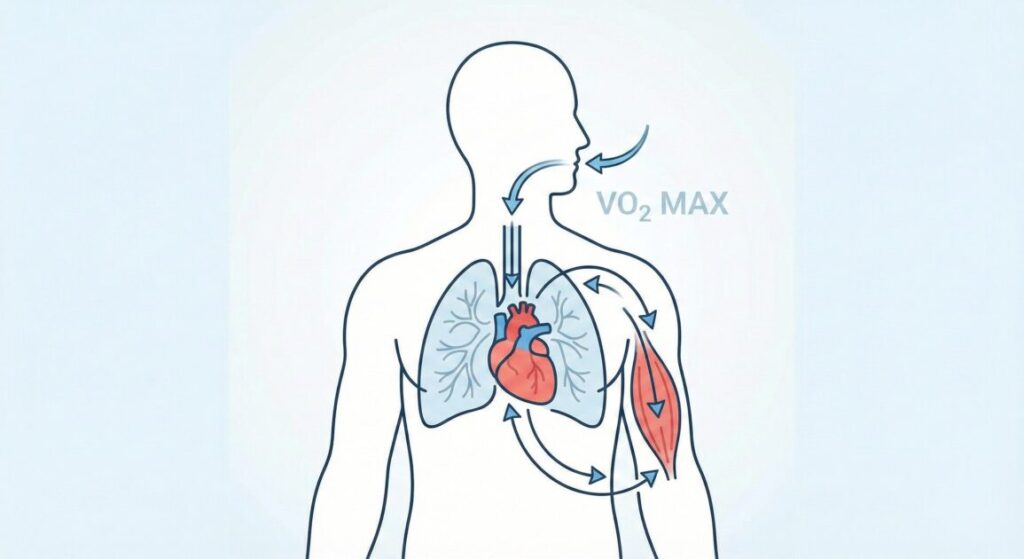
The core scientific concept behind the Cooper Test is maximal oxygen consumption, commonly known as VO2 max. VO2 max is the maximum amount of oxygen your body can use during intense exercise. It is widely considered the gold standard of cardiorespiratory fitness.
A higher VO2 max indicates a more efficient heart and set of lungs, which can deliver more oxygen to your working muscles, allowing you to perform strenuous exercise for longer periods.
Directly measuring VO2 max requires expensive treadmill testing in a lab with specialized gas analysis equipment. However, the Cooper Test provides a means of assessing maximal oxygen intake through a field test.
Extensive research, including meta-analysis and systematic review studies, has shown a high correlation between the distance covered in a 12-minute run and laboratory-measured VO2 max. By inputting your test distance into a specific formula or using a cooper test calculator, you can obtain a fairly accurate estimate of your maximal oxygen consumption. This makes it a valuable tool for assessing physical fitness without the need for a clinical setting.
How to Perform the Cooper Test
Performing the Cooper Test is straightforward but requires preparation and maximum effort. The most suitable venue is a standard 400-meter running track, which allows for precise measurement of the distance covered. You’ll need a stopwatch to time the 12-minute duration accurately.
Before you begin, a proper warm-up is crucial. Spend 10-15 minutes performing light jogging, dynamic stretches, and some short strides to prepare your muscles and cardiovascular system. Once you are ready, start the stopwatch and begin running.
The goal is to cover the maximum possible distance in 12 minutes. Pacing is key; you don’t want to start with a sprint and burn out, but you also don’t want to finish with too much energy left. An experienced runner will aim for a steady, challenging pace.
If you are less experienced, it’s perfectly acceptable to alternate between running and walking, but keep in mind this is a test of your maximal aerobic capacity, so push yourself.

When the 12 minutes are up, stop immediately and mark your exact location. Then, calculate the total distance you covered. If you’re on a track, you can easily do this by counting your laps and adding the final partial lap.
Record the distance in either kilometers or miles. After the test, perform a cool-down with a slow recovery jog and static stretching to help your body recover.
Interpreting Your Test Results
Once you have your total distance, you can interpret your Cooper test results to understand your cardiovascular fitness level. The distance you covered can be plugged into a formula to estimate your VO2 max.
One common formula for calculating VO2 max (in ml/kg/min) from the distance in kilometers (d) is: VO2 max = (22.351 x d) – 11.288. Alternatively, you can use a formula based on miles.
Your calculated VO2 max or the raw distance can then be compared to normative data tables. These tables categorize fitness levels from “Very Poor” to “Superior” based on your age and sex. For instance, a 25-year-old male covering 2.8 km might be in the “Excellent” category, while the same distance for a 50-year-old male would be considered “Superior.”
It’s important to remember that while the Cooper test is a well-regarded physical fitness test, it provides an estimate. Factors like your running experience, pacing strategy, motivation, and even the weather can influence your score. For a more precise measure, a laboratory-based treadmill test is required. However, for tracking your own training progress or for use by coaches to assess large groups, the Cooper test results are a valuable and quite accurate tool.

Improving Your Cooper Test Score
If your Cooper test results show room for improvement, the good news is that aerobic fitness is highly trainable. To improve your Cooper test score, you need to focus on increasing your body’s ability to transport and use oxygen. This is primarily achieved through consistent endurance training.
A well-rounded training plan should include a mix of steady-state runs, which build your aerobic base, and more intense sessions like interval training. Interval training, where you alternate between periods of high-intensity running (like a sprint or a fast per-mile pace) and recovery jogs, is particularly effective at boosting VO2 max. For example, you might run hard for 3 minutes, then jog for 2 minutes, and repeat this cycle several times.
Consistency is key. Aim for at least 3-4 sessions of aerobic exercise per week. As your fitness improves, you can gradually increase the duration and intensity of your workouts. It’s also beneficial to incorporate other forms of cardio, like cycling or swimming, to improve your overall cardiorespiratory fitness without the high impact of running.
By following a structured training program, you can expect to see a significant improvement in your Cooper test score and your overall aerobic endurance. You can re-take the Cooper test every 6-8 weeks to track your training progress.

The Cooper Fitness Test remains a classic and valuable tool for assessing aerobic fitness. Its simplicity, requiring only a stopwatch and a place to run, makes it accessible to everyone from the casual exerciser to the elite athlete.
By measuring the distance you can cover in 12 minutes, you gain a powerful insight into the efficiency of your cardiovascular system and an estimate of your VO2 max.
Whether you are looking to establish a baseline for a new training program, track your progress over time, or simply see where you stand compared to age and sex norms, the Cooper Test provides a practical and reliable benchmark. With consistent endurance training, you can improve your score, enhance your cardiorespiratory health, and enjoy the many benefits of a fitter, more resilient body.