In the dynamic trucking industry, long hours behind the wheel are a given, making health and fitness a critical, yet often overlooked, component of a professional driver’s life. The sedentary nature of truck driving, combined with irregular schedules and limited access to healthy food options, places truckers at the highest risk for chronic health problems.
A study by the National Institute for Occupational Safety and Health found that truck drivers are more likely to suffer from obesity, heart disease, and diabetes than workers in other professions. These health problems are not only detrimental to your health but can also impact your career and overall safety on the road.
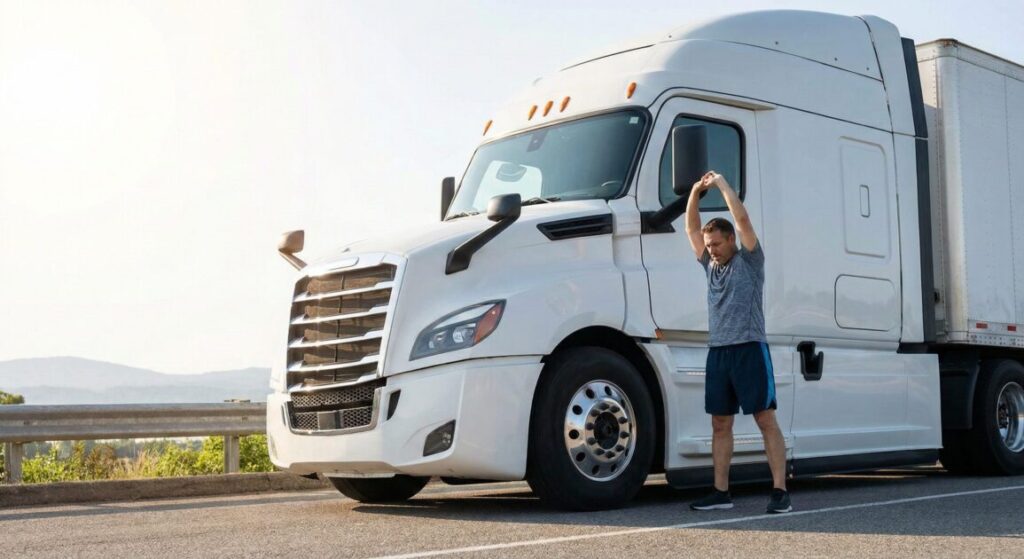
Taking a breather: A truck driver incorporates simple stretches into his break to stay limber and energized.
A healthy trucker is a safer trucker, with better reaction times and higher alertness. Therefore, prioritizing your fitness is not just about looking good; it’s a fundamental aspect of your professional responsibility and long-term well-being. By adopting healthy habits, you can mitigate these risks and stay fit on the road.
Building Your On-the-Road Fitness Routine
Simple & Effective Exercises
You don’t need a fully equipped gym to stay in shape as a truck driver. An effective fitness routine can be built around your truck using bodyweight exercises and minimal equipment. Regular exercise can help you stay fit even with a busy schedule. Aim to incorporate physical activity into your daily routine whenever you have a break. A 7 rules of on-the-road fitness plan can be as simple as performing a 15-minute workout every three hours. Here is a sample trucker workout you can do anywhere:
Warm-up: Start with 5 minutes of light activity like walking around your truck or doing jumping jacks to get your blood flowing.
Push-ups: Great for your chest, shoulders, and triceps. You can do them against the side of your truck or on the ground.
Squats: An excellent exercise to strengthen your legs and core.
Shoulder Shrugs: A simple movement to release tension in your neck and shoulders, which is common after long driving hours.
Leg Stretches: Crucial for maintaining flexibility and preventing stiffness.
Jump Rope: A fantastic cardiovascular exercise that is highly portable.
Resistance Bands: These bands add an extra dimension to your workout and can be used to exercise all muscle groups. They are lightweight, easily portable workout equipment that won’t take up much space in your cab.
Creating a Sustainable Plan
To see results and stay active, you need a formal plan that you can stick to. Start by setting realistic fitness goals. Don’t try to do too much too soon; consistency is key. Find time to exercise during your pre-trip inspection, while waiting for a load, or during your mandatory rest breaks. A fitness app can be a great tool to track your progress and provide you with new exercise routines. The best exercises for truck drivers are those that are convenient and address the specific physical challenges of the job. Remember, a short, easy truck driver workout is better than no workout at all.
Fueling for the Road: Nutrition and Hydration
Exercise also goes hand-in-hand with proper nutrition. Your diet plays a significant role in your overall health and fitness journey. The convenience of truck stop food often leads to unhealthy eating habits, but with a little planning, you can make better choices. Stock your cab with healthy snacks like fruits, nuts, and protein bars to avoid the temptation of junk food. Packing your own meals is one of the best tips to help you stay healthy and maintain a healthy weight. Focus on lean proteins, whole grains, and plenty of vegetables. Hydration is equally important; drink plenty of water throughout the day and limit sugary drinks. Proper nutrition and fitness are the cornerstones of a healthy lifestyle for any long-haul driver.
Fueling for the long haul: A driver demonstrates how to maintain a nutritious diet while working on the road.
In conclusion, while truck driving can be an unhealthy occupation in America, you have the power to change that narrative for yourself. By incorporating regular physical activity, making smart food choices, and committing to a consistent routine, you can boost your fitness and ensure you stay healthy and happy on the road for years to come.
In the fast-paced fitness world, efficiency is often the key to consistency. Whether you are stepping into a fitness class for the first time or looking to shake up your current fitness routine, you have likely heard the term EMOM thrown around. But what does EMOM mean in fitness?
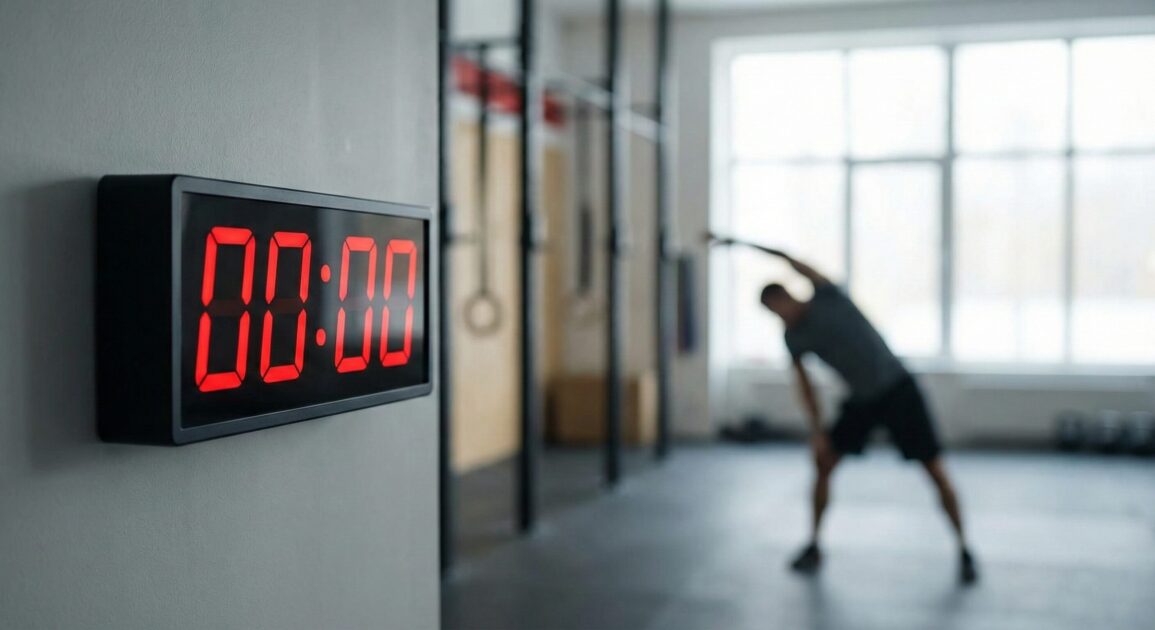
EMOM stands for “every minute on the minute.” It is a specific type of interval training used to build strength, improve endurance, and maximize calorie burn in a set amount of time.
Unlike a standard gym session where you might rest for minutes between sets, an EMOM workout challenges you to work against the clock, keeping your heart rate elevated and your focus sharp.
Understanding the Definition
At its core, EMOM stands for a simple yet demanding structure. You perform a certain number of reps of a specific exercise at the start of every minute. Once you finish your reps, the remaining time in that minute is your recovery time.
For example, if your workout calls for 10 squats and it takes you 40 seconds to complete them, you have 20 seconds of rest before the next minute begins. If it takes you 45 seconds, you only get 15 seconds of rest. The clock does not stop, and neither do you until the total duration of the workout is complete.
This emom structure forces you to manage your pace; go too slow, and you have no time to catch your breath. Go too fast, and you might compromise your form.
The Benefits of EMOM Training
There are many reasons why fitness experts and athletes love this training style. One of the primary benefits of emom workouts is that they are incredibly time-efficient. Because the rest is built-in rest, there is no wasted time checking your phone or wandering around the gym. You know exactly how long the workouts last—usually between 10 to 30 minutes.
This type of workout is also excellent for measuring progress. In your fitness journey, it can be hard to track improvements in conditioning. However, with EMOMs, you can see clear data. If you struggle to finish your reps in the first minute today but handle them with ease next month, you know you have improved. Furthermore, the pressure of the clock encourages you to maintain intensity, helping you get your heart rate up and keep it there, similar to high-intensity interval training (HIIT).
Whether you use body weight as resistance or add external weights, this method allows you to reap the benefits of both cardiovascular and strength training simultaneously.
EMOM vs. AMRAP and HIIT
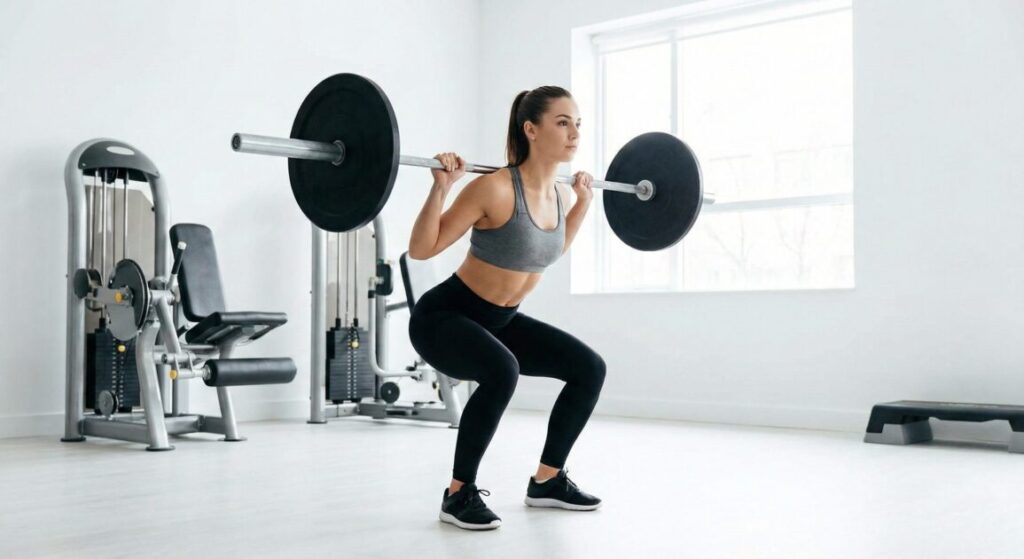
Foundational strength: Mastering the barbell squat is a key component of effective EMOM and HIIT programming.
It is common to confuse EMOM with other types of training like AMRAP or generic HIIT workouts. While they all fall under the umbrella of high-intensity conditioning, their structures differ.
EMOM (Every Minute on the Minute): You have a fixed rep count to hit at the top of every minute. Your rest depends on how fast you work.
AMRAP (As Many Reps/Rounds As Possible): In an AMRAP workout, you try to complete as much work as possible in a fixed time frame without a structured rest period.
HIIT (High-Intensity Interval Training): A HIIT workout typically involves fixed work and rest intervals (e.g., 20 seconds work, 10 seconds rest) regardless of how many reps you do.
The unique advantage of EMOM work is that it rewards efficiency. In an AMRAP, working faster just means doing more work. In an EMOM, working faster (while using correct form) earns you more recovery period. This makes it a great form of exercise for those who need a structured goal to stay motivated.
How to Structure Your First EMOM
Reaching peak power: Explosive movements like the tuck jump are essential components of high-intensity EMOM (Every Minute on the Minute) training.
Ready to program EMOM into your week? You can create a simple bodyweight workout or use equipment like kettlebells and dumbbells. The key is to pick a rep count that you can sustain. A good rule of thumb is to aim for work that takes about 40 seconds, leaving you 20 seconds rest.
Here is a basic structure for a 12-minute session:
Minute 1: 15 Squats (aim for 45 seconds work)
Minute 2: 10 Push-ups
Minute 3: 10 Burpees
Minute 4: Rest (or hold a plank for the fourth minute if you are advanced)
Repeat this cycle three times. At the start of each minute, you attack the set of exercises with focus. By the time the next set rolls around, you should be slightly recovered but still breathing hard. This type of interval allows you to maintain a high standard of movement even as you tire.
Examples of EMOM Workouts to Try
You can tailor EMOM workouts to try based on your level of fitness and fitness goals. Here are two variations:
1. The Bodyweight Burner (No Equipment)
This bodyweight routine is perfect for beginners or those training at home.
Duration: 10 Minutes
Even Minutes: 12 Lunges (alternating legs)
Odd Minutes: 10 Burpees
Goal: Work to get your reps done quickly to maximize rest.
2. Strength and Conditioning Mix
This workout helps build strength and tests your endurance.
Duration: 20 Minutes
Minute 1: 10 Goblet Squats
Minute 2: 12 Kettlebell Swings
Minute 3: 8 Push-ups
Minute 4: Rest
Note: Ensure you complete the certain number of reps with correct form before the minute to complete runs out.
Tips for Success
As you learn about EMOM, remember that pacing is everything. Don’t sprint through the first minute only to burn out by the fifth. EMOM workouts may look easy on paper, but the cumulative fatigue is real. Always prioritize quality over speed; if your form breaks down, reduce the number of repetitions.
Ultimately, whether you are a CrossFit athlete or just trying to stay active, using an EMOM is a powerful tool. It keeps you accountable—the clock is your coach, telling you exactly when to work and when to rest. So, next time you are short on time, set a timer for 20 minutes, pick your moves, and move at the start of every minute.
Starting a fitness journey is an exciting commitment to your health and well-being. However, the initial enthusiasm can sometimes fade if you don’t see results as quickly as you’d like. This is where understanding how to effectively track your fitness progress becomes crucial.
It’s not just about the number on the scale; it’s about recognizing the multitude of physical changes and performance improvements that indicate you’re making progress. By learning to measure fitness progress in various ways, you can stay motivated, adjust your fitness routine as needed, and ultimately achieve your fitness goals.
This comprehensive guide will walk you through the science behind fitness progress and provide you with practical tools to track your journey effectively.
Why Measuring Your Fitness Progress Matters
Embarking on a new fitness routine without a way to track your progress is like setting sail without a compass. You might be moving, but you won’t know if you’re heading in the right direction. Measuring your progress is essential for several reasons.
The pen is mightier than the plate: documenting your habits and reflections to ensure long-term success.
First, it helps you set realistic fitness goals. When you have a baseline and can see how far you’ve come, you can set achievable milestones. Second, seeing tangible proof that your fitness routine is working is a powerful motivator. It helps you stay on track when the going gets tough.
Finally, tracking helps you identify when you’ve hit a plateau, indicating it might be time to change up your workout or consult a certified personal trainer to continue making progress effectively.
The Psychology of Tracking and Motivation
Seeing results from working out provides a significant psychological boost. It validates your efforts and reinforces the positive behavior of sticking to your physical activity plan. When you track your fitness, you’re essentially creating a feedback loop. Positive changes, no matter how small, release dopamine, which makes you feel good and encourages you to keep going.
This is why it’s so important to find ways to track your fitness that go beyond just one metric. Seeing improvement in different areas can help you stay motivated even if one indicator, like your weight, temporarily stalls.
Setting Realistic and Measurable Goals
To measure progress effectively, you need to start with clear goals. Instead of a vague goal like “get fit,” try something specific and measurable, such as “be able to run 5 kilometers without stopping in three months” or “increase my deadlift by 10% in six weeks.”
These types of fitness milestones are easier to track and provide a clearer sense of achievement. A certified personal trainer can be a valuable resource to help you set appropriate goals based on your current fitness level and lifestyle.
Going Beyond the Scale: Alternative Ways to Track
For many, the bathroom scale is the primary indicator of fitness progress. While it can be a useful tool, it’s often a misleading one. Your weight can fluctuate daily due to factors like water retention, hormones, and digestion, which have nothing to do with your actual progress. More importantly, the scale doesn’t tell the whole story of body composition changes.
Documenting the journey: using both quantitative measurements and visual milestones to stay motivated.
You could be losing fat and gaining muscle at the same time—a process known as body recomposition—and the number on the scale might barely budge. This is a fantastic sign of progress, but the scale won’t show it. To get a more accurate picture of how your body is changing, you need to use other methods.
Taking Body Measurements
One of the most effective ways to track your fitness is by taking body measurements. Using a simple tape measure, you can track changes in the circumference of your waist, hips, chest, arms, and thighs.
These measurements can reveal fat loss and muscle gain that the scale misses. You might notice your clothes fit differently, feeling looser in some areas and tighter in others due to increased muscle tone. This is a clear sign that you’re making progress and your body composition is improving.
The Power of Progress Photos
Another powerful tool is to take progress photos. These provide a visual record of your body’s physical changes over time. When you look at yourself in the mirror every day, it’s hard to see the subtle shifts.
But when you compare photos taken a month apart, the differences can be striking. To take effective progress pictures, use consistent lighting, wear similar clothing, and take photos from multiple angles (front, side, and back) at regular intervals, such as every four weeks.
Understanding Body Recomposition
It’s crucial to understand that true fitness progress often involves body recomposition—losing fat while building muscle. Muscle is denser than fat, so it takes up less space in your body. This is why you can look leaner and your clothes can fit better even if your weight remains the same.
Experiencing muscle gain is a fantastic sign of progress that will improve your metabolism and overall functional fitness. Don’t get discouraged by the scale; instead, focus on how your body is changing and feeling.
Performance-Based Indicators of Progress
While aesthetic changes are a common goal, performance improvements are often a more reliable and motivating indicator of fitness progress. When you focus on what your body can do rather than just how it looks, you’ll find a deeper sense of accomplishment.
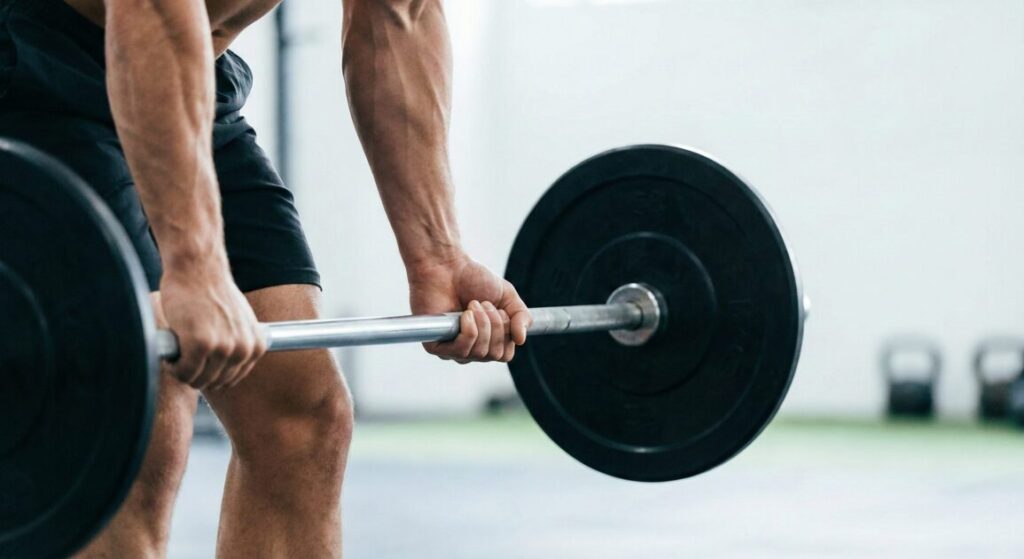
Precision and power: focusing on the mechanics of a heavy lift to drive performance gains.
Tracking your workouts is the best way to monitor these performance changes. A fitness journal, app, or fitness tracker can be a great way to track your sets, reps, weights, and times.
Tracking Strength and Endurance Gains
Are you lifting heavier weights than you were a month ago? Can you perform more push-ups or hold a plank for longer? These are clear signs of getting stronger and building muscle. In terms of endurance, perhaps you can run a mile faster, swim more laps without stopping, or get through a high-intensity interval training (HIIT) class with less fatigue.
These improvements directly reflect a boost in your fitness level and are a fantastic sign that your fitness routine is working.
Monitoring Daily Energy Levels
An often-overlooked but significant indicator of fitness progress is your daily energy levels. As your cardiovascular health and muscular endurance improve, you’ll likely find that everyday tasks become easier.
You won’t feel as winded climbing stairs, and you’ll have more sustained energy throughout the day. This increase in vitality is a very real and positive sign of progress that goes beyond the gym.
Feeling the Difference in Daily Activities
Functional fitness is all about how your workout translates to real-life situations. You might notice that carrying groceries, playing with your kids, or doing yard work feels less strenuous. You’re getting stronger not just for the gym, but for life. Paying attention to these subtle improvements can be a great way to see the changes you’re making.
The Role of Nutrition and Recovery
You can have the best workout routine in the world, but if your nutrition and recovery are lacking, your progress will stall. Tracking these factors is just as important as tracking your exercise.
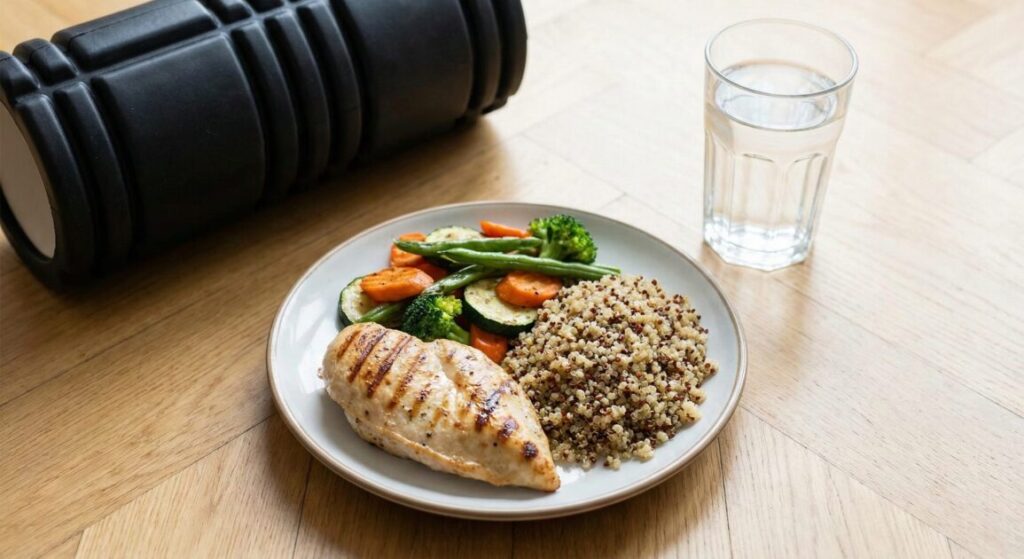
The essential trio for recovery: nutrient-dense whole foods, proper hydration, and myofascial release.
Many people find that tracking your calories or macronutrients (protein, carbohydrates, and fats) can be a helpful tool for understanding how food affects their performance and body composition.
The Importance of Sleep and Rest Days
Recovery is where the magic happens. Your muscles repair and grow stronger during rest, not during the workout itself. Tracking your sleep quality and quantity with a fitness tracker can provide valuable insights. Are you getting enough restorative sleep? Are your stress levels affecting your recovery? Ensuring you take regular rest days is also crucial to prevent overtraining and injury.
How Nutrition Affects Your Progress
The food you eat provides the fuel for your workouts and the building blocks for muscle repair. Eating a balanced diet rich in protein, healthy fats, and complex carbohydrates will support your strength training and endurance goals.
If you’re not seeing the results you want, a closer look at your nutrition might reveal the answer. You might need to adjust your calorie intake or protein consumption to better align with your fitness goals.
In conclusion, achieving real progress in your fitness journey takes time and consistency. It’s not a linear path, and there will be ups and downs. By using a variety of methods to measure fitness progress—from tracking your workouts and body measurements to monitoring your energy levels and recovery—you can get a complete picture of your health and fitness.
This holistic approach will help you stay motivated, make informed decisions about your routine, and ultimately achieve your long-term goals. Remember, the most important thing is that you’re making progress and becoming a healthier, stronger version of yourself.
Embarking on a fitness journey can be one of the most rewarding decisions you ever make. A well-structured 30-day fitness challenge provides the perfect framework for beginners to build healthy habits, improve body composition, and discover the joy of movement.
This comprehensive guide will walk you through a complete 30-day program, from setting your initial fitness goals to completing your very next workout with confidence. We’ve designed this workout plan to be an easy-to-follow, great workout that will challenge you without being overwhelming. Get ready to transform your body over the next 30 days!
Preparing for Your 30-Day Fitness Journey
Before you jump into your first month of exercise, a little preparation can make a huge difference. This section is all about setting the stage for a successful 30-day challenge.
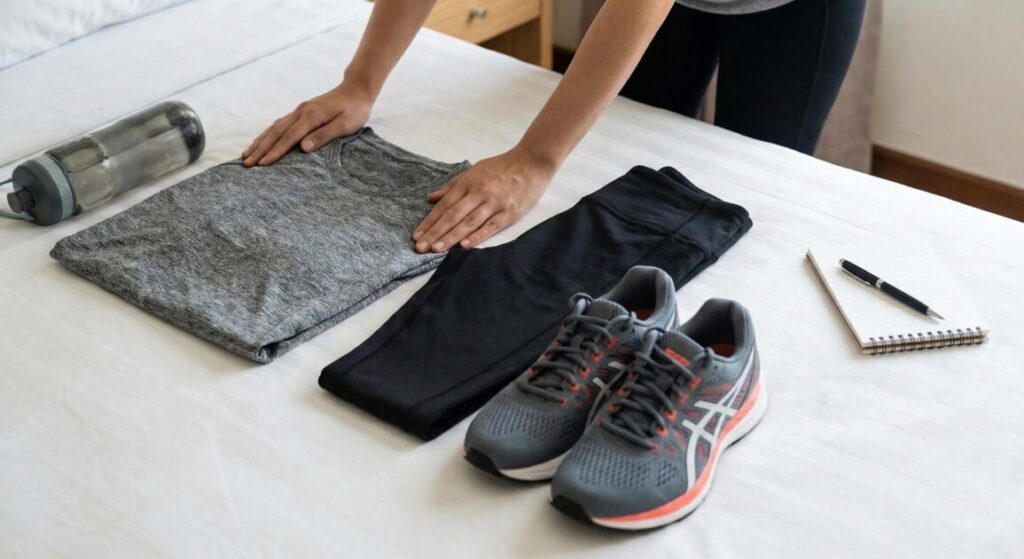
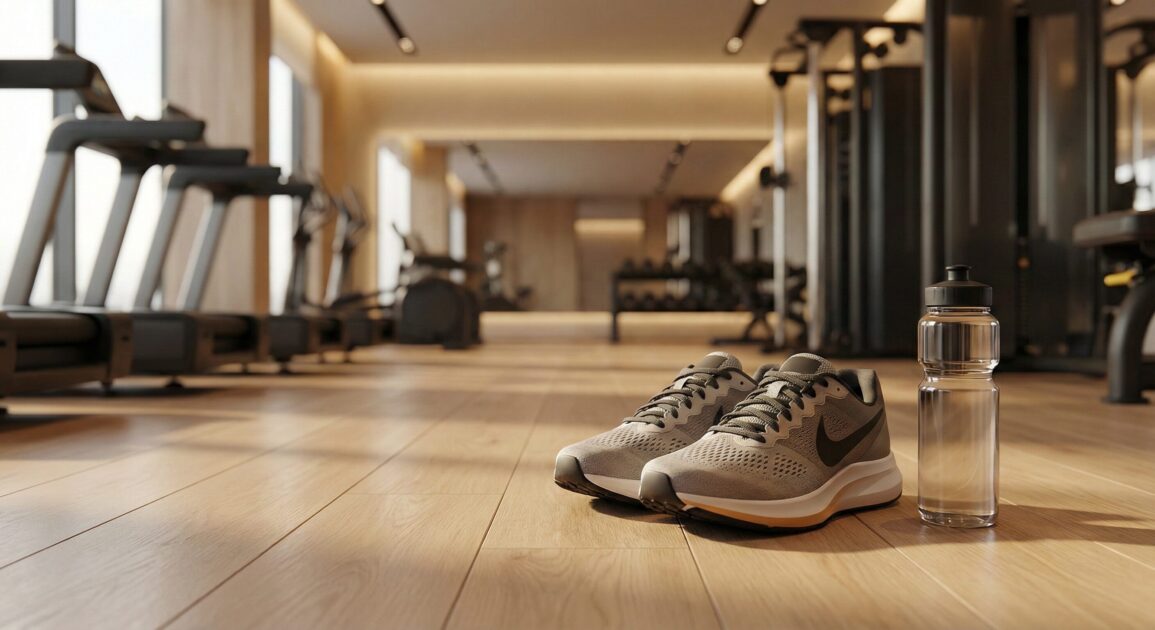
Removing the friction: preparing your gear the night before to ensure success in your fitness challenge.
Setting Realistic Goals and Tracking Progress
The first step is to define clear, attainable goals. Instead of aiming for drastic changes, focus on achievable milestones like completing every scheduled workout or being able to do more reps of a certain exercise by week 2. To keep yourself accountable, consider using a journal to track your daily workouts, how you feel, and any improvements in your endurance. Seeing your progress on paper is a powerful way to stay motivated throughout the 30 day challenges.
Essential Gear for a Home Workout
You don’t need a fancy gym membership to get a solid workout. A great home workout can be done with minimal equipment. For this 30-day beginner workout plan, we recommend having a comfortable mat, a pair of light dumbbells for strength training, and a good pair of athletic shoes. As you progress, you might explore other tools, but these basics are perfect for getting started with exercise.
Understanding the Importance of Warm-ups and Cool-downs
Never skip your warm-up! A 5-10 minute session of light cardio and dynamic stretching prepares your body for the work ahead by raising your heart rate and increasing blood flow to the muscles in your body. Similarly, a cool-down with static stretches helps with recovery and flexibility. These simple steps are crucial for preventing injury and ensuring you can stick with the program.
Structuring Your 30-Day Workout Challenge
A well-designed workout schedule is the backbone of any successful fitness routine. This plan balances different types of training to provide a comprehensive full body workout while allowing for adequate recovery.
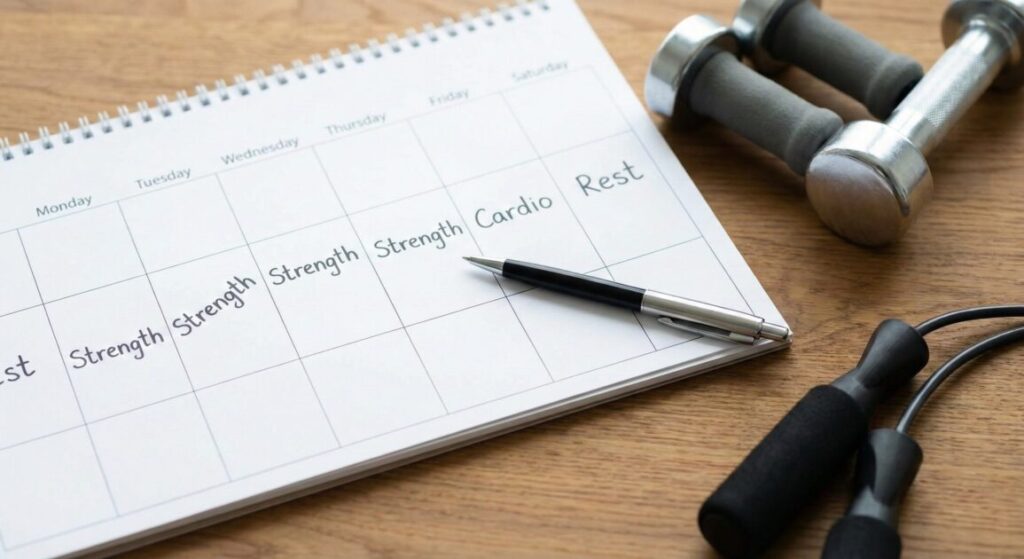
Planning for progress: a structured weekly routine for a 30-day fitness challenge.
The Weekly Schedule Breakdown
For week 1, we’ll start with a manageable rhythm. A common and effective structure is to exercise for three days, take a rest day, exercise for two more days, and then take another rest day. This ensures you’re active most of the week but also gives your body time to recover. As your fitness level improves, you can adjust the frequency, but for now, aiming for at least one solid rest day per week is key.
Balancing Cardio, Strength, and Flexibility
A complete fitness program incorporates multiple elements. We’ll alternate between strength workouts that focus on building muscle and cardio workouts to improve your heart health and stamina. You might also weave in a low-impact session like pilates or yoga to enhance flexibility. This variety keeps things interesting and ensures you’re targeting every muscle group.
The Critical Role of Rest Days
Rest days are not lazy days; they are a vital part of your workout program. During rest, your muscles repair and grow stronger. Neglecting rest can lead to burnout or injury. So, listen to your body and don’t hesitate to take an extra rest day if you’re feeling exceptionally sore or fatigued. The goal is to make fitness a sustainable part of your life, not a short-term punishment.
Sample Workout Routines for Beginners
Here are some examples of the types of workouts you’ll be doing. Remember, the key is proper form over the number of reps. If you’re unsure, consider consulting a personal trainer or joining group fitness classes to learn the basics.
Building a strong foundation: mastering the lunge as part of a daily beginner routine.
Full-Body Strength Training Focus
A full body strength routine is excellent for beginners. It allows you to work multiple muscle groups in a single session. Your routine might include bodyweight staples like squats, push ups (modified on knees if needed), and lunges, along with a simple dumbbell workout for your arms and shoulders. Aim to challenge your muscles with 2-3 sets of 10-12 repetitions for each exercise, focusing on good form.
Introduction to HIIT and Cardio
To boost your cardiovascular health, we’ll introduce some basic interval training. A beginner HIIT workout might involve alternating between 30 seconds of a more intense activity like marching in place or jumping jacks, followed by 30 seconds of rest. Repeating this cycle for 15-20 minutes is a time-efficient and highly effective cardio workout.
Core and Ab Specific Workouts
A strong core is essential for overall stability and preventing back pain. You can dedicate a short session or part of your strength workout to an ab challenge. Simple but effective moves like planks, crunches, and bird-dogs will help you build a solid foundation.
Tips for Success and Staying Motivated
The physical part of the challenge is only half the battle; the mental aspect is just as important. Here’s how to keep your head in the game and reach your fitness goals.
Preparation is the foundation of success for a 30-day beginner fitness challenge.
Finding Your “Why”
Why did you decide to start this 30-day challenge? Maybe you want to feel more energetic, fit into an old pair of jeans, or set a good example for your family. Whatever your reason, write it down and keep it visible. Remembering your “why” will help you push through when you don’t feel like doing that next workout.
Listening to Your Body and Making Adjustments
Your body provides the best feedback. If a new exercise causes sharp pain, stop immediately. If you’re feeling completely drained, a light walk might be a better option than a high-intensity session. It’s okay to modify the workout plan as needed. The goal is to complete the workout, not to be perfect. This flexibility will help you avoid injury and keep going for the next 30 days and beyond.
Celebrating Non-Scale Victories
Don’t get hung up on the number on the scale. Your body composition is changing in ways that a scale can’t always measure. Celebrate other victories: feeling stronger, having more energy during the day, sleeping better, or being able to do exercises like squats with better form. These are all signs that your new fitness routine is working.
By the end of this 30-day program, you’ll have built a solid foundation for a lifelong fitness journey. You’ll be stronger, more confident, and ready to take on whatever new workout or wellness program comes next. So, lace up your shoes, take a deep breath, and let’s get started on your body 30 day workout challenge!
The journey to a healthier life often begins with a spark—a sudden burst of energy where you feel ready to hit the gym and transform your life. However, relying solely on that initial feeling is rarely enough.
Research suggests that most people who start a new fitness routine drop out within the first few months. The difference between those who quit and those who succeed isn’t willpower; it’s understanding how to find motivation and cultivate it into a lasting habit.
The science of grit: understanding the physiological and mental breakthrough that occurs during high-intensity effort.
Whether you are looking to stay fit, build muscle through strength training, or simply increase your steps per day, understanding the psychology behind what keeps you moving is essential.
It is not just about having the right workout clothes or the perfect playlist; it is about building a system that helps you push past the days when you simply do not want to get to work.
Understanding the Psychology of Drive
To maintain motivation over the long term, it is crucial to distinguish between external and internal drivers. Extrinsic motivation is when you are motivated to work out for rewards, such as looking good for a vacation or receiving praise from others. While this can help motivate you initially, it often fades.
The psychology of progress: turning abstract intentions into concrete, time-bound goals.
Internal motivation, or intrinsic motivation, is far more powerful. This is when motivation comes from within—you exercise because of the better you feel mentally and physically, or because you enjoy the challenge of a new workout.
Research shows that shifting your focus from aesthetic results to how exercise makes you feel—enhancing your mood, energy, and health—creates a sustainable cycle of success. When you focus on these immediate internal rewards, you are more likely to stay on track with your health and fitness plans.
Setting SMART Goals
A common reason people lose motivation is that their targets are too vague. Simply saying you want to “get in shape” provides no roadmap. To achieve your goals, you need to apply the SMART framework: Specific, Measurable, Achievable, Relevant, and Time-bound.
Setting goals that are measurable allows you to track progress, which is one of the best fitness motivation tips available. Instead of a general aim, set a target to run a 5k in under 30 minutes or attend a fitness class three times a week. When you see tangible progress, such as an increase in the weight you lift or a faster mile time, it releases dopamine, which helps keep you motivated.
One step closer to your goals: preparation is the secret to staying consistent.
It is also vital to adjust your expectations to your current fitness level. If you are just starting, a high-volume workout regimen might lead to burnout. Start small to get you started, achieve that goal, and then increase your workout intensity as you gain confidence.
Optimizing Your Environment and Routine
Willpower is a finite resource. To stay motivated to work out, you must reduce the friction between you and your exercise routine. This is where preparation becomes key.
Packing your gym bag the night before, laying out your gym clothes, or keeping your running shoes by the door can significantly increase the likelihood that you will head to the gym.
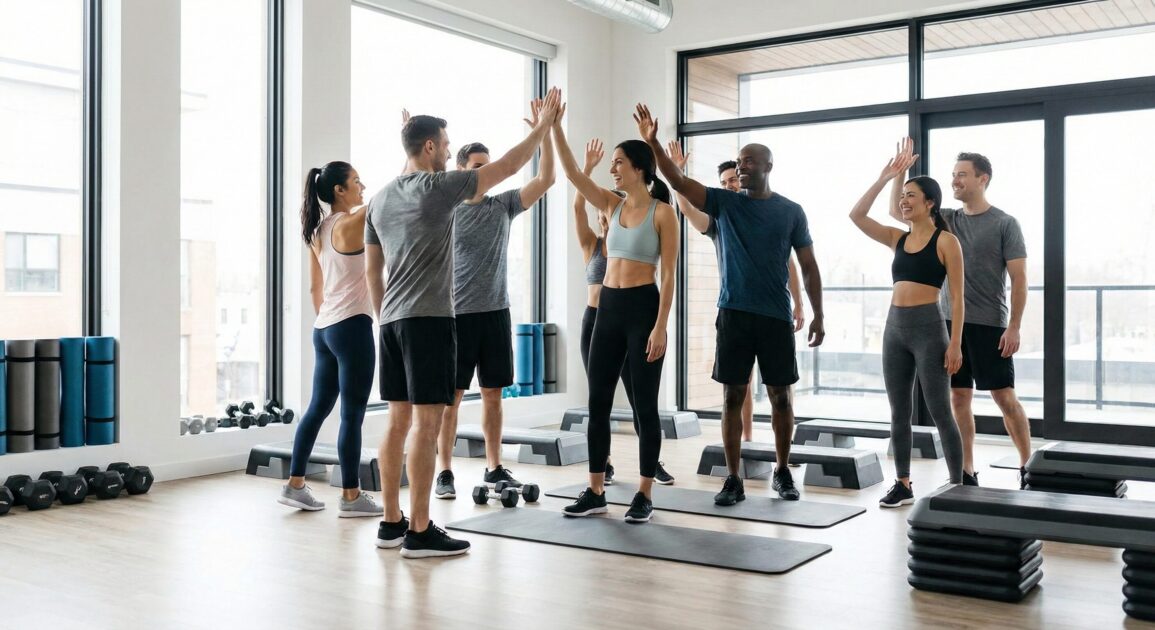
Stronger together: finding motivation through community and shared success.
Creating a consistent workout schedule treats exercise as a non-negotiable appointment rather than a choice. If you are short on time, high-efficiency workouts like high-intensity interval training (HIIT) can deliver results without requiring hours of gym time.
The gym environment itself also plays a role; finding a space where you feel more confident and comfortable can make every workout more enjoyable.
Even simple changes, like upgrading your gear, can have a surprising effect. Putting on high-quality workout clothes can trigger a psychological shift known as “enclothed cognition,” making you feel more capable and motivated to exercise.
The Power of Accountability
It is much harder to skip a session when someone else is counting on you. A sense of accountability is a powerful gym tool. This could mean finding a workout buddy or asking a friend to join you for a morning jog. When you know someone is waiting, the motivation to go increases drastically.
For those who need professional guidance, working with a personal trainer is one of the most effective investments. A trainer not only designs a safe and effective workout routine tailored to your fitness goals but also provides the external push needed when your internal drive is low.
They help you stay motivated by tracking your progress and ensuring you show up. Even joining a group fitness class can provide a community aspect that helps you make it to the gym on days you feel lethargic.
Overcoming Slumps and Plateaus
Motivation over time naturally fluctuates. There will be periods where you face a lack of motivation to work out. This is normal. The key is not to view a missed workout as a failure but to get back to it immediately.
When you feel stuck, try mixing things up. If you usually lift weights, go for a run. If you are tired of the treadmill, try a new workout style like yoga or boxing.
Sometimes, fitness motivation quotes or a motivational video can provide a temporary boost to get moving, but discipline is what keeps you going. Focus on the goals you set and remind yourself why you started your fitness journey.
Remember, motivation comes after the action, not before. You often have to start moving before you feel motivated to workout.
By combining smart goals, a supportive environment, and a strong sense of accountability, you can build a lifestyle where regular exercise is not a chore, but a rewarding part of your day.
Starting a new fitness journey is exhilarating, but without the right preparation, it can also be overwhelming. Whether you are a seasoned athlete or just stepping onto the gym floor for the first time, having the right fitness essentials can make or break your success. From the perfect workout routine to the items you bring to the gym, every detail contributes to your performance and muscle growth.
This guide covers everything you need to know about packing your gym bag, choosing the best workout gear, and optimizing your training for maximum results.
Gym Bag Essentials: What to Pack for Success
Your gym bag is your mobile command center. Packing it correctly ensures you can head straight from the gym to work or vice versa without missing a beat. The ultimate gym bag isn’t just about carrying things; it’s about organization and readiness.
The complete gym bag: staying organized with gear, tech, and hygiene essentials for a seamless transition from work to workout.
The Absolute Must-Haves
At the core of your packing your gym bag strategy should be the non-negotiables. First and foremost, a high-quality water bottle is critical. You must hydrate to maintain peak performance, especially during intense cardio workouts or HIIT sessions. Look for a durable, leak-proof bottle that fits easily into a side compartment.
Next, investing in moisture-wicking workout clothes is a game-changer. Breathable fabrics keep you cool and dry, preventing chafing and discomfort. A fresh set of clothes is vital, particularly if you plan on a post-workout shower. Don’t forget a microfiber towel—it’s a must-have for wiping down equipment and keeping sweat at bay.
Footwear and Accessories
Your choice of footwear dictates your range of motion and stability. For leg day essentials like the squat and lunge, flat-soled shoes are preferred over cushy running shoes to ensure proper power transfer. However, if your fitness goals lean more towards endurance and treadmill intervals, supportive running shoes are key.
Headphones are another must-have gym staple. A good playlist pump-up through noise-canceling headphones can help you zone out distractions and focus on your training routine.
Hygiene and Recovery
A well-stocked bag includes items for post-workout care. Pack wipes to clean your face and body immediately after exercising to prevent breakouts. If you are a fan of weightlifting, you might also pack lifting straps or a weightlifting belt to support heavy lifts.
Building Your Workout Routine: Equipment and Exercises
Whether you are training at a commercial facility or setting up a hotel workout, the equipment you use defines your type of fitness.
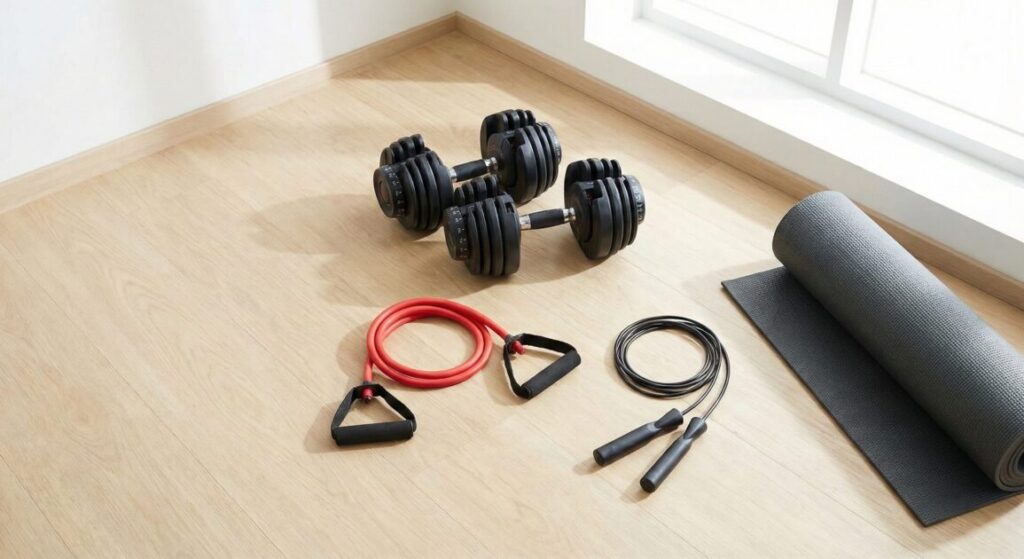
The essential toolkit: versatile gear for building strength and endurance from the comfort of home.
Strength Training Staples
For those focused on strength building, the barbell and dumbbell are kings. Regular dumbbells are fantastic, but for home or travel, adjustable ones offer versatility. Weight training with free weights allows for a full range of motion that static machines can’t always provide.
To strictly target muscle recovery and mobility, a resistance band is indispensable. A bands set often comes with a door anchor, allowing you to simulate machine exercises like lat pulldowns or tricep press-downs anywhere. They are excellent to warm up your muscles before you grab the heavy iron.
Cardio and Endurance
If endurance is your aim, mix up your cardio sources. While cardio machines like the elliptical and rower are staples for many gym-goers, don’t underestimate the humble jump rope. It’s a portable essential that torches calories and improves coordination.
For a new workout challenge, try bodyweight workouts. Exercises like the push-up, air squat, and burpee require no equipment and are perfect for every workout, regardless of your fitness level. Calisthenics and Pilates also rely heavily on bodyweight exercises to engage your core and build stabilizer muscles.
Optimizing Performance and Recovery
Reaching your fitness goals isn’t just about the hour you spend sweating; it’s about what happens before and after.
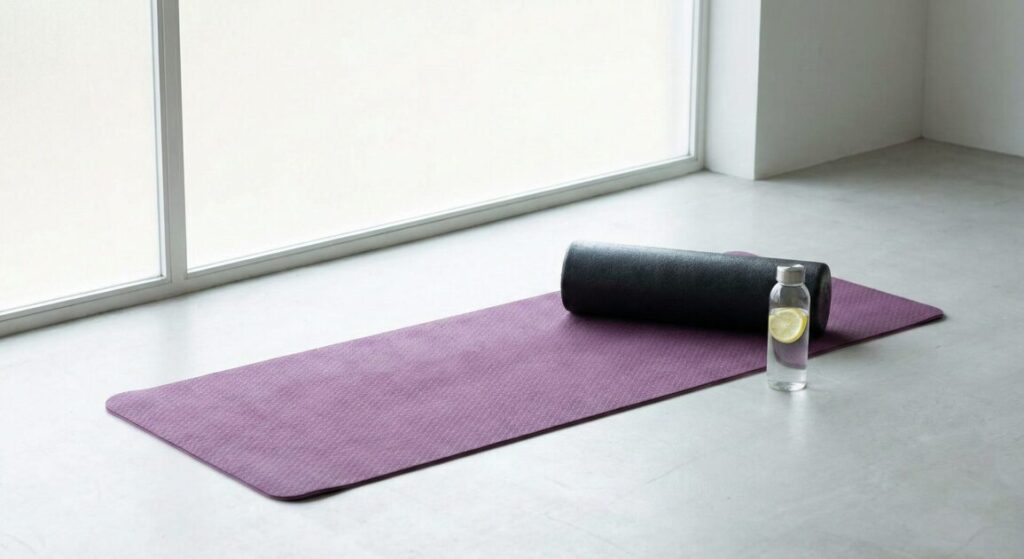
The foundation of recovery: prioritizing stretching and hydration to sustain your 30-day fitness progress.
Form and Progression
Maintaining proper form is safer and more effective than lifting heavy with bad technique. Whether you are doing a deadlift or a simple yoga mat stretch, focus on quality movement. Add resistance or weights as you progress only when your technique is solid. This progressive overload is the secret to consistent muscle growth.
For those who enjoy CrossFit or functional training, having a strong grip is essential. You might find that adding a resistance band to your pull-up bar helps you build the necessary strength to perform unassisted reps eventually.
The Post-Workout Ritual
After you crush your gym training, shift your focus to recovery. Muscle recovery starts the moment you put down the weight. Stretching on a yoga mat helps improve flexibility and reduce soreness.
Organize your workout bag so you’re ready to refuel and refresh instantly. A compartment for dirty laundry keeps your clean gear fresh. Having a go-to gym bag ready by the door eliminates barriers, ensuring you never skip a session.
In the end, the fitness essentials you choose should support your unique workout journey. From the gym essentials in your bag to the workout gear on your back, every piece plays a role in helping you become the strongest version of yourself. Whether you join one gym or travel the world, these basics will keep you on track.
Running a fitness business requires more than just providing equipment and a schedule of classes. To truly thrive, you need to foster a sense of community and keep your members motivated.
This is where a well-structured fitness challenge comes into play. Whether you manage a large gym or a boutique studio, implementing the right group fitness challenge ideas can revitalize your members’ fitness journey, increase retention, and build a culture of healthy competition.
This guide covers effective gym challenges designed to suit different fitness levels, from high-intensity workout challenges to holistic mindfulness challenges.
Why Group Fitness Challenges Boost Engagement
A challenge is a great way to break the monotony of a regular fitness routine. When members work together to achieve a common goal, it creates a layer of accountability that is often missing from solo training. Group fitness challenges do more than just improve physical results; they build social bonds.
When a challenge helps members feel part of a tribe, they are less likely to cancel their membership. By introducing friendly competition or a shared fitness goal, you encourage members to push past their perceived limits. Furthermore, a challenge on their social media can serve as powerful organic marketing for your fitness business, showcasing the fun group fitness atmosphere you cultivate.
Competitive Performance Challenges
For members who thrive on data and rivalry, performance-based activities are the best fitness challenge ideas. These focus on tangible metrics like reps, weight, or time.
The AMRAP Challenge
An AMRAP challenge (As Many Reps/Rounds As Possible) is perfect for high-energy groups. You can set a specific timeframe, such as 10 or 20 minutes, and a type of workout circuit. This challenge is designed to test endurance and mental grit. It allows members of all fitness levels to participate since they move at their own pace, yet it still fosters a competitive spirit as they try to beat their previous scores.
Strength and Rep Benchmarks
Specific exercise challenges, like a push-up challenge or a personal best challenge on the squat rack, are classic options. These allow members to track tangible progress over a month. You might create a leaderboard to highlight those who increase their fitness metrics the most, not just those lifting the heaviest weights. This ensures the challenge focuses on improvement rather than just raw strength.
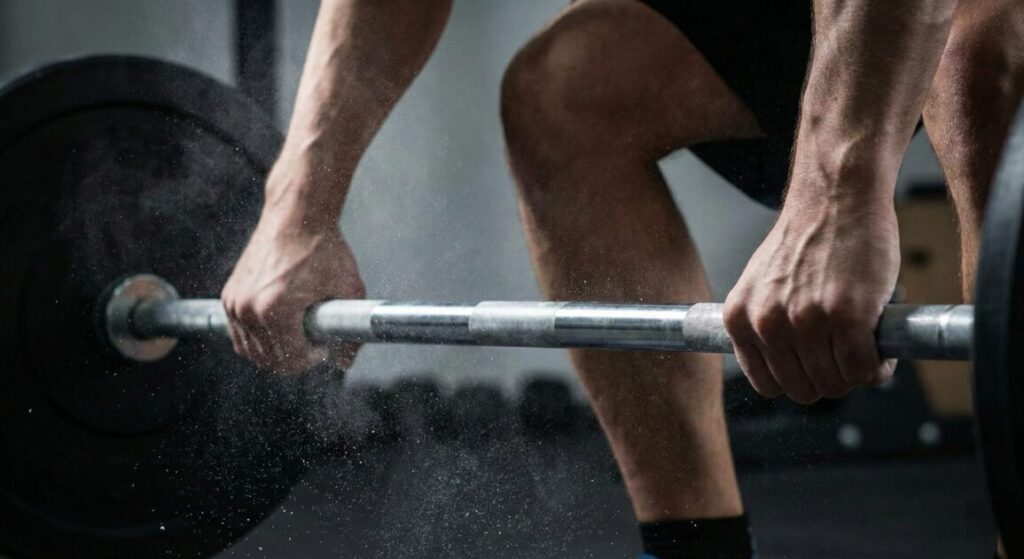
Building raw power: pushing past your limits to master foundational movements in a group strength challenge.
Consistency and Habit-Building Challenges
Not every challenge involves lifting heavy or moving fast. Often, the best fitness results come from consistency. These ideas are ideal for beginners or those trying to re-establish a habit.
The 30-Day Attendance Streak
A 30-day fitness challenge focused purely on attendance is a simple yet powerful tool. The goal is to attend a certain number of group sessions or fitness activities within the month. A workout streak challenge rewards dedication rather than athletic prowess, making it a challenge that’s accessible to everyone.
The Step and Cardio Challenge
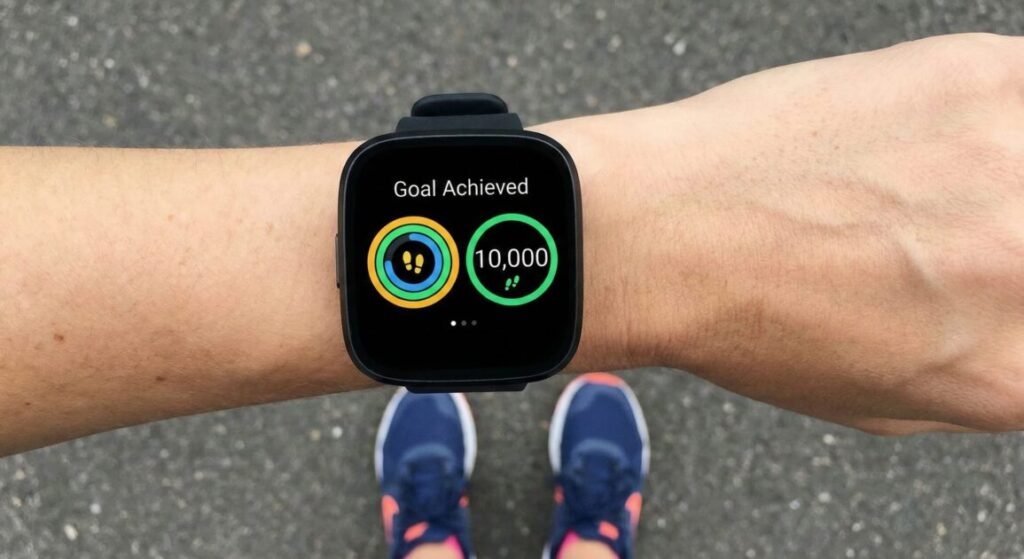
A walking challenge or step challenge is an excellent low-barrier option. Members can use fitness trackers or apps to log their daily activity. This type of challenge also works well as an office fitness challenge for corporate clients. It encourages movement outside the gym, helping members integrate physical activities into their daily lives.
Mission accomplished: hitting the 10,000-step milestone as part of a daily cardio challenge.
Holistic and Wellness Challenges
A well-rounded fitness program isn’t just about sweating; it’s about recovery and lifestyle. Wellness challenges can differentiate your gym by showing you care about the member’s total health.
Nutrition and Hydration
A nutrition challenge or eating challenge (focused on healthy habits like eating more vegetables, not quantity) can be paired with physical fitness goals. You might challenge members to drink a certain amount of water daily or cut out added sugars. This challenge encourages members to look at how they fuel their bodies, which inevitably improves their fitness experience in the gym.
Mindfulness and Mobility
Introducing a yoga challenge or a stretching challenge can help prevent injury and improve recovery. A mindfulness challenge might involve 10 minutes of meditation after a workout. This approach to fitness highlights that mental health is just as important as physical strength. It is a great challenge for high-stress times of the year.
The power of the pause: integrating mindfulness into your fitness challenge to balance physical effort with mental clarity.
Team and Community-Based Challenges
Sometimes the challenge is perfect when it’s shared. Group activities where members work in teams can skyrocket camaraderie.
The Cumulative Goal
Set a massive target for the entire gym to hit together, such as 100,000 push-ups or cycling across the country (virtually) in a month. This group challenge unites everyone. Every gym member contributes to the total, meaning a beginner’s effort is just as valuable as an elite athlete’s. It’s a challenge ideal for fostering a supportive environment where everyone completes the challenge together.
Partner Challenges
Pairing members up for a weight loss challenge or a fitness tracker competition adds a layer of accountability. Knowing a partner is counting on them helps keep the challenge top of mind. These challenges can be tailored to ensure partners have similar fitness goals or complementary schedules.
How to Launch a Successful Fitness Challenge
To ensure a successful fitness event, you need a plan. A structured challenge requires clear rules and an easy way to track progress.
Define the Goal: Decide if the challenge focuses on weight loss, attendance, or performance.
Choose the Duration: A 30-day fitness challenge is standard, but shorter or longer options work too depending on the type of challenge.
Track Progress: Whether it’s a whiteboard in the lobby or a digital app, ensure there is a visual representation of progress. Fitness milestones should be celebrated publicly.
Offer Incentives: While personal fitness gains are the main reward, prizes like free merchandise or membership discounts help members stay motivated.
Promote Heavily: Use your social channels. Share ideas that boost excitement and feature stories of members who are committed to their fitness.
Conclusion
Implementing variety of challenge options throughout the year keeps your gym dynamic and exciting. From a rigorous push-up challenge to a restorative yoga challenge, there is something for everyone. The best fitness challenge ideas are those that strike a balance between challenge and fun, ensuring members of all fitness levels feel welcome.
By promoting your fitness challenges effectively and supporting your members as they work together to achieve their goals, you solidify your gym’s reputation as a place of transformation and community. A challenge requires effort to organize, but the payoff in member loyalty and engagement is worth every second.
In the realm of exercise and sport science, consistent effort is the cornerstone of progress. We train to build strength, endurance, and power, relying on the body’s remarkable ability to adapt to the demands we place upon it.
However, there is a flip side to this adaptive process, a concept known as the principle of reversibility. Often summarized by the adage “use it or lose it,” reversibility in fitness dictates that the beneficial fitness and performance adaptations gained through training will diminish if the training stimulus is reduced or ceases completely.
This principle is one of the four general training principles—along with overload, specificity, and individualization—that guide effective training programs. For any fitness professional or enthusiast, understanding the mechanisms and implications of reversibility is crucial for maintaining fitness levels over the long term and for safely guiding a client back on track after a period of inactivity. It serves as a reminder that fitness is a dynamic state, not a permanent possession, and that consistent physical activity is required to sustain it.
The Science Behind Reversibility: How Fast Does Fitness Fade?
The process of losing fitness gains, often referred to as detraining, does not happen overnight, but it can occur faster than many expect. The rate at which you experience reversibility depends on several factors, including your pre-break fitness level, your training history, and the specific type of fitness you’ve built.
Research in sport science indicates that different components of physical fitness fade at different rates. Aerobic capacity, or endurance, is often the first to decline. Significant reductions in cardiovascular fitness can be observed after as little as two weeks of complete training cessation. This is largely due to a rapid decrease in blood volume and a reduced ability of the muscles to utilize oxygen efficiently.
The countdown of inactivity: visualizing how quickly fitness gains can begin to reverse during a long break.
Muscular strength and power, on the other hand, tend to be more resilient. While some loss in neural drive (the nervous system’s ability to activate muscle) can occur within a few weeks, significant atrophy of muscle fibers typically takes longer to set in.
An individual with years of training history may retain a base level of strength for months after stopping, whereas someone with only a few months of training may lose their gains much faster. Ultimately, the body is highly efficient and will not expend energy maintaining muscle mass or metabolic machinery that is not being used.
Common Causes and Triggers for Detraining
The topic of reversibility is relevant to everyone, from elite athletes to the casual fitness enthusiast. Life is unpredictable, and there are numerous reasons why someone might be forced to take a break from their regular training routine, leading to a loss of beneficial fitness.
One of the most common triggers is illness or injury. A significant injury can require weeks or even months of complete rest to heal properly, during which time the effects of detraining will inevitably occur. Similarly, a severe illness can leave the body in a weakened state, making a return to sport or exercise difficult.
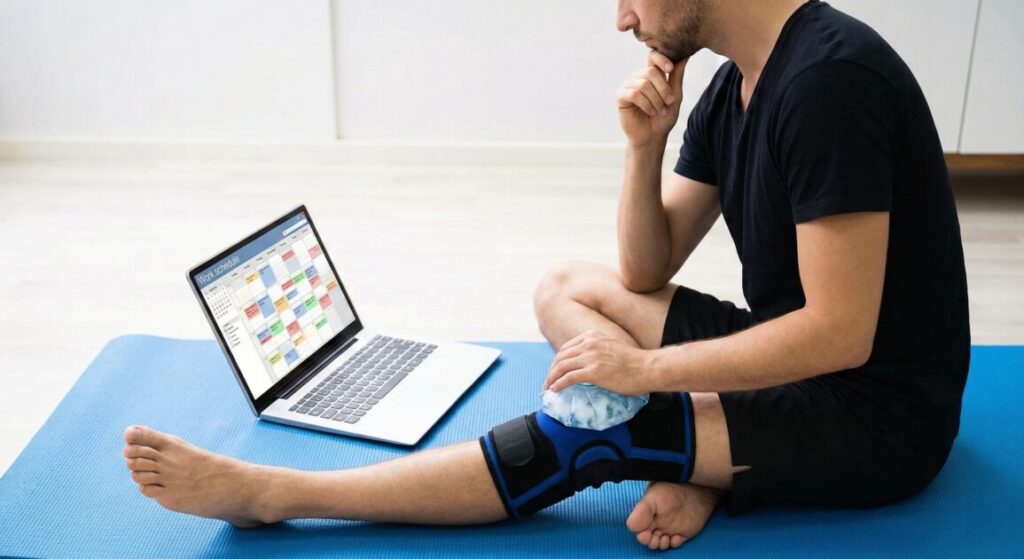
Navigating the obstacles: identifying how injury and a demanding work schedule can lead to fitness reversibility.
Beyond physical limitations, lifestyle factors play a major role. A new job, a move, family commitments, or a busy travel schedule can all disrupt a well-established routine, leading to a reduction in the number of sessions per week or a complete cessation of training.
For athletes, the off-season is a planned period of reduced activity, but without a structured maintenance program, the effects of the principle of reversibility can still be significant. Understanding these common causes is the first step for health and fitness professionals in helping clients navigate these inevitable breaks.
Strategies for Preventing and Managing Fitness Reversibility
While some loss of fitness during a break is often unavoidable, the effects of reversibility can be mitigated with proactive strategies. For fitness professionals, the goal is to help clients maintain as much of their hard-earned fitness as possible and then facilitate a safe and effective return to their previous level.
The most effective strategy for preventing severe detraining is to maintain some level of physical activity, even if it is greatly reduced.
The concept of “active recovery” is key here. Reducing the frequency or duration of workouts while maintaining the intensity can be surprisingly effective at preserving fitness gains. For example, an endurance athlete might reduce their volume by 50% but still include some short, high-intensity intervals to stimulate their aerobic system.
Consistency is key: incorporating regular stretching as a strategy to prevent the effects of fitness reversibility.
When a client is ready to return to training after a break, it is crucial to assess their current readiness and fitness level. Trying to jump back into their pre-break routine is a recipe for injury. A gradual re-introduction to exercise, starting with lower intensity and volume and slowly applying the training principle of overload, is essential. This allows the body the necessary adaptation period to readjust to the demand without being overwhelmed.
By using training as a means to slowly rebuild, you can help your client get back on track and regain their previous fitness levels safely and effectively. It’s always a good idea to revisit the ACE Integrated Fitness Training® (ACE IFT®) Model for a structured approach to program design that accounts for a client’s current stage of readiness.
In conclusion, reversibility in fitness is a natural and inevitable biological process. It is not a failure, but simply a response to a change in stimulus.
By understanding the science behind it, recognizing the common triggers, and implementing smart strategies for maintenance and return, fitness professionals can empower their clients to navigate the ups and downs of their fitness journey with confidence and long-term success.
For many of us, the goal of aging isn’t just about living longer—it’s about living better. As we enter our golden years, the ability to perform daily activities with ease becomes the true measure of our health and wellness.
This is where functional fitness comes into play. Unlike traditional bodybuilding, which might focus purely on aesthetics, functional fitness for seniors prioritizes movements that mimic real-life tasks. It is about maintaining the strength, balance, and coordination necessary to lift a grandchild, carry groceries, or simply get up from a sturdy chair without struggle.
What is Functional Fitness?
To define functional fitness, we look at the practical application of exercise. Functional fitness is a way of training that prepares the body for real-life activities. It focuses on exercises that mimic the movements you use every day, such as bending, lifting, pushing, pulling, and twisting. For older adults and adults over 60, this approach is vital. It shifts the focus from isolating individual muscles to training movement patterns that involve multiple muscle groups working together.
Preparation is part of the process. Staying active outdoors begins with the mobility to handle the small details of your routine.
By integrating functional movement into a daily routine, seniors can enhance functional capabilities that directly translate to independence. Whether you are 65 and older or just looking to stay active, this type of training builds the foundation for a high quality of life. It isn’t just about fitness levels; it is about ensuring you have the physical capacity to do what you love.
The Benefits of Functional Training for Seniors
The benefits of functional training extend far beyond muscle tone. For active older adults, engaging in a regular fitness program is one of the most effective ways to maintain independence and quality of life.
Improving Functional Performance and Safety
One of the primary goals is to reduce the risk of injury. Falls are a significant concern among older adults, but functional training exercises specifically target balance and coordination to mitigate this danger. By improving functional strength and reaction times, we can significantly reduce the risk of falls. Furthermore, resistance training and weight-bearing activities strengthen the muscles and bones, combating age-related muscle loss.
Enhancing Daily Life
Functional fitness helps seniors perform activities of daily living with greater ease. From reaching for a high shelf to getting in and out of a car, these exercises focus on range of motion and joint mobility. Regular exercise helps manage health conditions, supports cardiovascular health, and boosts overall energy. Ultimately, functional fitness exercises for seniors are designed to ensure you can continue living in your own home safely and comfortably.
Key Components: Strength, Balance, and Mobility
A comprehensive functional training program is built on three pillars: strength, balance, and mobility. Neglecting one can compromise the effectiveness of the others.
Balance is the foundation of independence. Engaging in functional movements like this helps maintain stability and confidence at any age.
Strength and Endurance
Muscle strength is the engine that drives movement. Strength training exercises, particularly those focusing on leg strength and upper body strength, are crucial. We aren’t just talking about lifting heavy weights; functional strength training often uses bodyweight exercises or light resistance to build strength that applies to real-world tasks. This training builds muscular strength and endurance, allowing you to stay active for longer periods without fatigue.
Balance and Coordination
Balance training is essential to improve balance and stability. As we age, our proprioception—the body’s ability to sense its position in space—can decline. Specific exercises that challenge your stability, such as standing on one leg or walking heel-to-toe, help seniors maintain their footing on uneven terrain. This is a critical component in reducing the risk of falling.
Mobility and Flexibility
Mobility training ensures that joints move freely through their full range of motion. Stiffness can limit movement and lead to pain. Functional exercises emphasize stretching and dynamic movements that keep the body supple. Good mobility allows for better posture and efficient movement mechanics, which in turn reduces wear and tear on the joints.
Essential Functional Fitness Exercises
When designing a new exercise program, it is important to choose exercises into daily routines that are safe and effective. Here are some basic functional exercises that can be done at home or in group fitness classes.
Building strength where you live. Functional exercises using household furniture can safely improve mobility and daily independence.
The Squat
The squat is the king of functional exercises. It mimics the motion of sitting and standing. Performing a sit-to-stand motion from a sturdy chair is an excellent starting point to improve strength in the legs and glutes. This movement is vital for mobility and independence.
Upper Body Pushing and Pulling
To maintain upper body strength, incorporate movements like wall push-ups or resistance band rows. These exercises focus on the chest, shoulders, and back, helping with tasks like pushing open heavy doors or carrying heavy items. Grip strength is also a key indicator of overall health and should be trained through carrying exercises.
Core Exercises
Core strength acts as the central stabilizer for the body. A strong core protects the lower back and improves posture. Simple core exercises, rather than traditional crunches, should focus on stability—think planks or bird-dogs—which help seniors maintain balance and coordination during movement.
Lunges and Step-Ups
These exercises focus on single-leg strength and stability. They mimic climbing stairs or stepping over objects. If traditional lunges are too difficult, step-ups onto a low platform are a great alternative to specific exercises that improve mobility and leg power.
Creating a Safe and Effective Routine
Starting a fitness routine requires care, especially for community-dwelling older adults who may have pre-existing health conditions. It is always wise to consult with a healthcare professional before beginning.
Balance is the foundation of independence. Engaging in functional movements like this helps maintain stability and confidence at any age.
Structuring the Program
A well-rounded training program should include a mix of cardiovascular health activities, strength training, and flexibility work. High-intensity functional training can be adapted for seniors, but steady, consistent progress is safer. Aim for strength and mobility workouts 2-3 times a week.
Progression and Adaptability
Fitness training should be progressive. Start with exercises that mimic basic movements and gradually increase the difficulty as fitness levels improve. For example, once bodyweight squats become easy, holding a light weight can further improve strength. Personal fitness trainers can help tailor workouts to help address specific weaknesses.
Consistency is Key
Regular exercise helps maintain the gains made. Whether it’s through fitness classes or a home routine, consistency is what enhances functional longevity. Exercise for improving health and wellness is a marathon, not a sprint. By making physical fitness a habit, you ensure a higher overall quality of life.
Conclusion
Functional fitness for seniors is more than just a workout; it is a strategic approach to aging with dignity and vitality. By focusing on strength and coordination, mobility, and balance, we can reduce the risk of injury and ensure that our later years are filled with activity and joy. Whether you are just starting to exercise for seniors or are looking to refine your current routine, remember that every bit of movement counts. Functional fitness exercises empower you to navigate the world with confidence, proving that age is just a number when your body is prepared for the adventure.
Understanding the basic principles of exercise is the bridge between simply moving your body and training to get a better result. Whether your goal is improving cardiovascular fitness, building muscular strength and endurance, or enhancing general health, the path to success is governed by physiological laws.
Organizations like the American College of Sports Medicine have long established these guidelines to help individuals design safe and effective routines. By applying these principles to your training, you move beyond guesswork and start building a sustainable, results-driven lifestyle.
The Core Principles of Fitness
To better understand the principles behind effective fitness, we must look at how the body adapts to stress.
A well-designed training programme does not just happen; it is built on a foundation of scientific rules that dictate how we improve. While some models refer to the 5 principles or even 7 principles of exercise, the core concepts remain consistent: the body needs stress to grow, specificity to adapt, and time to recover.
Specificity and Overload
The principles include specificity, which dictates that the beneficial effects of training are directly related to the type of exercise you perform. If you want to increase your aerobic endurance, you must perform aerobic exercise.
Pushing the limits. Applying the overload principle through progressive resistance is essential for building significant muscular strength.
If your goal is larger muscles, you must engage in resistance training. This seems simple, but it is often overlooked.
The application of a particular exercise must match your physical fitness goals. For example, lifting heavy weights will improve strength and power exercises, but it will have a limited impact on your marathon time.
Hand-in-hand with specificity is the principle of overload. To improve your fitness level, you must exercise harder than your body is accustomed to. This does not mean training to failure every day, but rather subjecting your body to a stress that forces adaptation.
You can apply this by increasing the weight in strength training, running faster during interval training, or shortening rest periods. Without overload, the body has no reason to change.
Progression and Reversibility
Overload must be applied carefully through progression. If you make the exercise harder too quickly, you risk injury. A proper exercise routine involves gradually increasing the workload as your fitness capacity improves. Conversely, the principle of reversibility serves as a warning: use it or lose it. If you stop training, your hard-earned gains in muscle fibre recruitment and aerobic capacity will diminish.
The duration of training required to maintain fitness is generally less than what is needed to build it, but complete cessation leads to a rapid decline in performance.
The FITT Principle: Structuring Your Workout
To effectively apply these principles, sports medicine professionals utilize the FITT principle. This acronym stands for Frequency, Intensity, Time, and Type. It provides a structured framework to adjust your exercise program and ensure you are meeting the necessary criteria for improvement without overtraining.
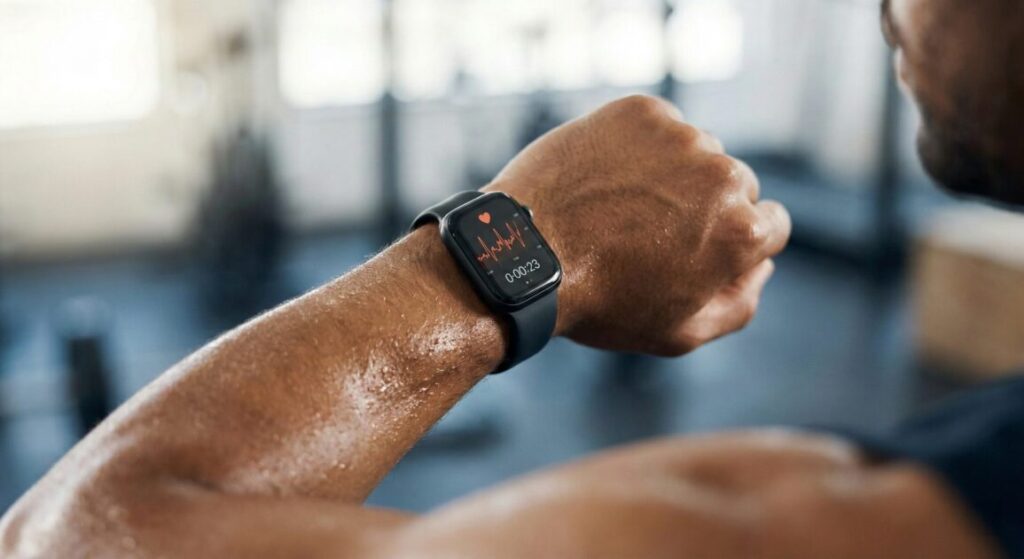
Precision in practice. Real-time data tracking helps you maintain the right intensity to reach your fitness goals.
Frequency and Intensity
Exercise frequency refers to how often you train. For general health, regular exercise is vital. However, the frequency will depend on your fitness level and the intensity exercise requires. Vigorous exercise places a higher demand on the body, often requiring more recovery days compared to moderate exercise.
Intensity is perhaps the most critical variable; it defines how hard you are working. In aerobic training, this might be measured by heart rate; in weightlifting, it is often a percentage of your one-rep max.
Time and Type
Time refers to the duration of training per session. This is inversely related to intensity; you can perform moderate activity for a long time, but high-intensity power exercises can only be sustained for short bursts.
Finally, the “Type” or mode of exercise determines the specific outcome. Your workout could consist of swimming, cycling, or weightlifting. Mixing the type of training can also help avoid plateaus and keep the physical activity and fitness journey engaging.
Recovery and Individualization
While the work happens in the gym, the results happen during rest. One of the most overlooked aspects of physical activity and exercise is the time to recover.
Reaching for recovery. Dedicated stretching time is as vital as the workout itself, ensuring your muscles remain flexible and ready for the next challenge.
Rest and Recovery
You cannot simply train continuously and expect growth. Exercise testing shows that the body repairs muscle fibre and replenishes energy stores during rest. If you do not allow adequate recovery, you risk overtraining and stalling your progress. A balanced exercise training plan includes rest days or active recovery sessions to ensure that the body creates the benefits of exercise.
Individual Differences
Finally, it is crucial to remember that everyone responds differently. The principles of specificity and overload apply to everyone, but the rate of adaptation varies. Genetics, age, and initial fitness level play huge roles. Therefore, an exercise program that works for an elite athlete may not be suitable for a beginner. Customizing your training to get a better outcome requires listening to your body and adjusting the FITT variables to suit your personal needs.